
At local community parks, adults over 70 are no longer moving the way they once did. Some still take their familiar slow loops along the path, tracking steps on their watches. But near the benches, another scene unfolds. A silver-haired woman carefully lowers herself to the ground, laughs as she steadies, then presses herself back up. Nearby, a slender man with a cane practices balancing on one leg, fingertips resting lightly against a tree. There are no machines, no weights, no mirrors — just people quietly practicing how to stay independent.

The longer you watch, the more obvious it becomes: the movement that matters most after 70 isn’t the one your fitness app celebrates.
The Overlooked Movement That Signals Longevity
After 70, daily walks and occasional gym visits often feel like enough. And they do help. Yet many geriatric specialists are pointing to something far more revealing: the ability to move smoothly between the floor and standing, and to control everyday positions without panic or strain.
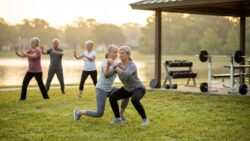 Morning exercises after 55 rebuild leg strength faster than weight training with less joint stress
This skill isn’t flashy. There’s no applause for it. It shows up in small moments — reaching into a low drawer, crouching to grab a dropped utensil, or calmly rising from the floor without someone pulling you up.

Why Getting Up From the Floor Matters
Researchers in Brazil developed the “sitting-rising test”, asking participants to sit on the floor and stand back up using minimal support. Over several years, they followed more than 2,000 adults. Those who struggled with this basic movement had a notably higher risk of earlier death. Not because the test itself was special, but because it exposed something deeper: strength, balance, and coordination working together.
Consider two people in their mid-70s who both walk daily. One can kneel to tie shoes, twist to reach shelves, and rise easily from the floor. The other cannot. Over time, their healthspan outcomes rarely match.
Why Level Changes Protect Independence
Walking keeps the heart and lungs active. But moving between the floor and standing trains survival skills. These movements rehearse real-life scenarios: a slip in the bathroom, dizziness near the bed, or a stumble outdoors that requires rolling, crawling, and standing again.
Regularly changing levels — high to low and back up — keeps joints mobile, reflexes sharp, and muscles responsive. It’s subtle and often ignored, yet it quietly determines whether later years feel free or fearful.
How to Practice Floor-to-Stand Safely After 70
Begin close to the ground, where many older adults feel the most uncertain. Choose a firm surface such as a carpet, mat, or folded blanket placed near a sturdy chair or bed. Start by practicing one simple action: lowering yourself to the floor slowly and with control, using hands or furniture for support.
Once seated or lying down, pause and breathe. Then retrace your steps, using the same supports to stand again. One controlled descent and rise counts as real training.
Simple Guidelines for Consistent Practice
- Start with full support and gradually reduce it over time
- Alternate sides when kneeling or standing
- Practice just 3–5 repetitions, two or three times a week
- Have someone nearby initially if confidence is low
The goal isn’t elegance. It’s repetition. Messy progress still builds independence.
Relearning the Script of Movement
With regular practice, weak points become clear: stiff hips, unstable ankles, fear of falling, or hesitation itself. As one physiotherapist explained, “Most older adults don’t lose strength — they lose the script for how to move.”
That script can be rewritten through small adjustments: using higher supports first, switching lead legs, or practicing partial movements like sitting on a low stool before reaching the floor. Consistency over months matters far more than perfect form.
Balance, Micro-Movements, and Allowing the Wobble
The movements that protect long-term independence aren’t only vertical. They also teach the body to manage uncertainty and instability. Small wobbles, quick corrections, and uneven surfaces all prepare the nervous system for real life.
Standing on one leg near the kitchen counter, rising from a chair without using hands, or lowering slowly into a seat are examples of micro-movements that quietly reduce fall risk.
Why These Small Movements Matter
Watching someone step sideways around furniture or back away from a low sofa reveals more about their future health than step counts ever will. Practicing balance and floor transitions gradually shifts something deeper: fear begins to fade.
One woman in her late 70s shared that the first time she stood up from the floor alone, she felt younger — not because her body transformed instantly, but because her confidence returned.
The Real Measure of Strength After 70
Gyms and walking routines still matter. But after 70, the movements that extend healthspan are quieter and more personal. They happen on carpets, kitchen tiles, and beside beds, in moments no one photographs.

Being able to pick up a fallen book, kneel in the garden, or rise from the floor after playing with a grandchild carries a deep sense of dignity and ownership over one’s body. These are the skills that allow older adults to keep living on their own terms — steady, capable, and unafraid.
| Point clé | Détail | Intérêt pour le lecteur |
|---|---|---|
| Floor-to-stand ability | Practice getting down to and up from the floor with support | Directly relates to independence and emergency situations |
| Balance micro-movements | Short drills like standing on one leg or slow chair rises | Reduces fall risk without long workouts |
| Consistency over intensity | 3–5 repetitions a few times a week | Makes the habit realistic and sustainable after 70 |
